
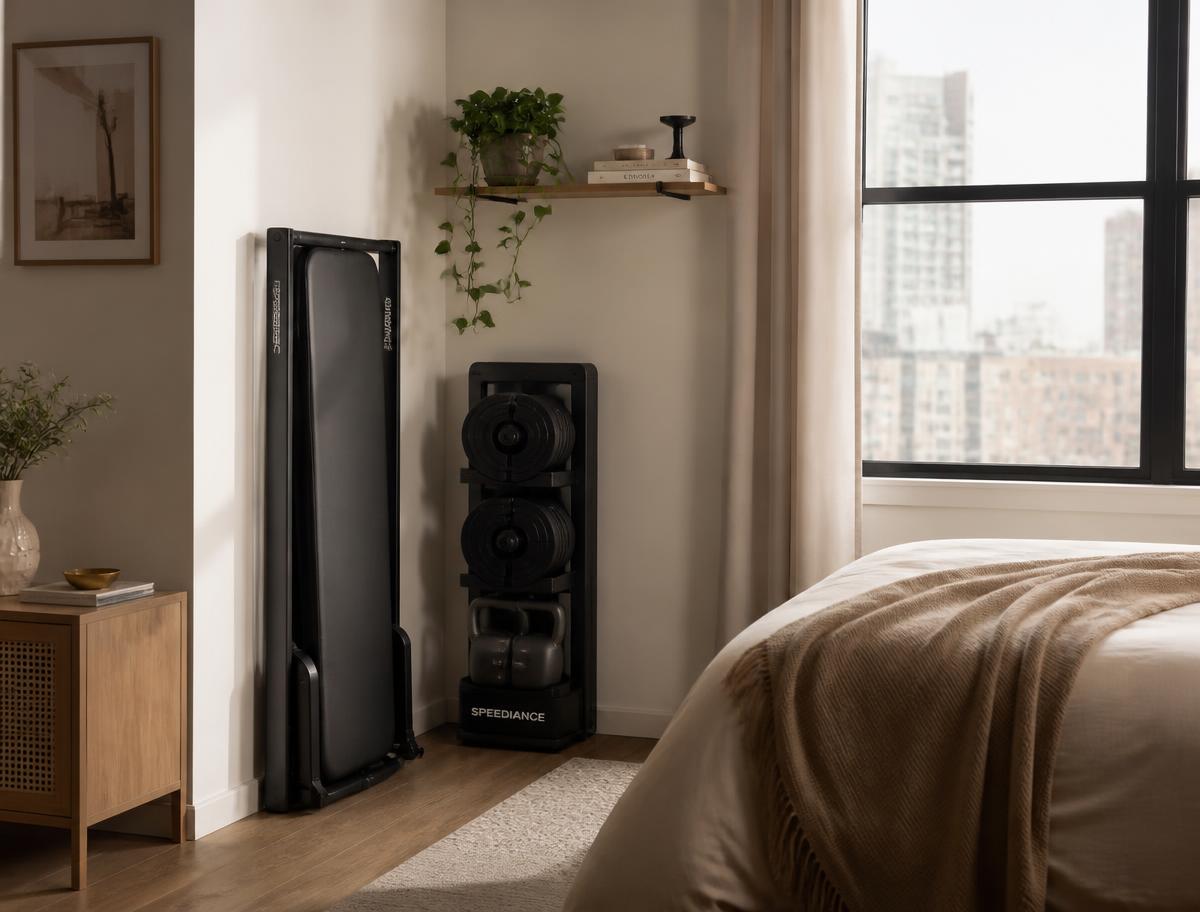
Most home gyms fail for the same reason: the equipment blocks the room it lives in. The fix is not more space — it is deciding where training starts and where the room goes back to being a room.
Start with the floor, not the equipment
Before choosing a single piece, mark out the area you can genuinely give up during a session. A rectangle roughly the length of your body plus arm reach is enough for the majority of strength and mobility work.
Protect that area properly. A dense mat keeps impact off the floor, keeps noise down for neighbours, and quietly signals that the space has a job.
Build in three zones
Compact spaces work best when equipment is grouped by what it does rather than stored in one pile.
- Load zone — anything with weight, kept low and close to a wall.
- Movement zone — the open floor you cleared, left permanently empty.
- Reset zone — mats, bands and mobility tools in a basket you can carry.
Choose pieces by their folded shape
In a small home, the footprint that matters is the one the equipment has when you are not training. Anything that folds flat, stands upright or slides under furniture earns its place; anything that stays assembled has to be worth the room it takes permanently.
That is the filter we apply to everything in the MODUFORM range, and it is why the storefront lists storage behaviour on every product page.
Make setup shorter than the excuse
If getting ready takes longer than three or four minutes, sessions get skipped. Keep the pieces you use most within one movement of the training area, and store the rest out of sight.